General Landscape Uses:
Accent shrub or small tree. Buffer plantings.
Ecological Restoration Notes: A very rare understory shrub in rockland hammocks in the Florida Keys. Rarely are more than 2 or 3 plants found growing together. Associated with primary or very old seconday hammocks.
Availability:
Commonly available at native plant nurseries in South Florida.
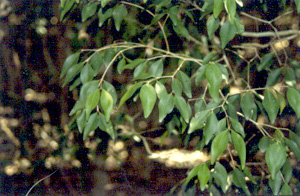
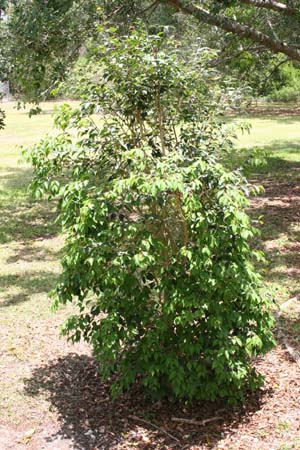
Description: Large shrub or rarely a small tree with an erect trunk(s) and a narrow, rounded crown. Trunks straight, sometimes multiple from the base, to 20 inches in diameter, but usually much smaller. Bark thin, light gray, mostly smooth. Leaves dark green, 1-2 inches long.
Dimensions: About 8-12 feet in height. Usually taller than broad.
Growth Rate: Slow.
Range:
Monroe County Keys and Miami-Dade County; West Indies, Mexico, Central America and northern South America. Very rare nearly throughout the Monroe County Keys. In Miami-Dade County, not known from the mainland; known only from the Florida Keys in and around Elliott Key in Biscayne National Park. For a digitized image of Elbert Little's Florida range map, visit the
Exploring Florida website.
 Map of select IRC data from peninsular Florida.
 Map of suggested ZIP codes from South Florida north to Jacksonville, Gainesville, and Cedar Key.
Map of ZIP codes with habitat recommendations from the Monroe County Keys north to Martin and Charlotte counties.
Habitats:
Map of suggested ZIP codes from South Florida north to Jacksonville, Gainesville, and Cedar Key.
Map of ZIP codes with habitat recommendations from the Monroe County Keys north to Martin and Charlotte counties.
Habitats: Rockland hammocks.
Soils: Moist, well-drained limestone soils, with humusy top layer.
Nutritional Requirements: Moderate; can grow in nutrient poor soils, but needs some organic content to thrive.
Salt Water Tolerance: Low; does not tolerate long-term flooding by salt or brackish water.
Salt Wind Tolerance: Low; salt wind may burn the leaves.
Drought Tolerance: Moderate; generally requires moist soils, but tolerant of short periods of drought once established.
Light Requirements: Light shade.
Flower Color: White.
Flower Characteristics: Semi-showy.
Flowering Season: All year; peak in summer.
Fruit: Orange-black berry, turning black.
Wildlife and Ecology: Provides food and cover for wildlife. Birds eat the fruits.
Horticultural Notes: Can be grown from de-pulped seed. Place in light shade. Germination usually occurs within 1 month.
References: Miami-Dade County Landscape Manual
(2005).
Comments: It is listed as endangered by the state of Florida and as critically imperiled in South Florida by The Institute for Regional Conservation. See also Florida Natural Areas Inventory's
Field Guide to the Rare Plants of Florida page (Chafin 2000).